Which coding standard should I check against?
Understand ships built-in configurations for many published standards. Pick the one your project is obligated to; you can copy and tailor it (see run your first check).
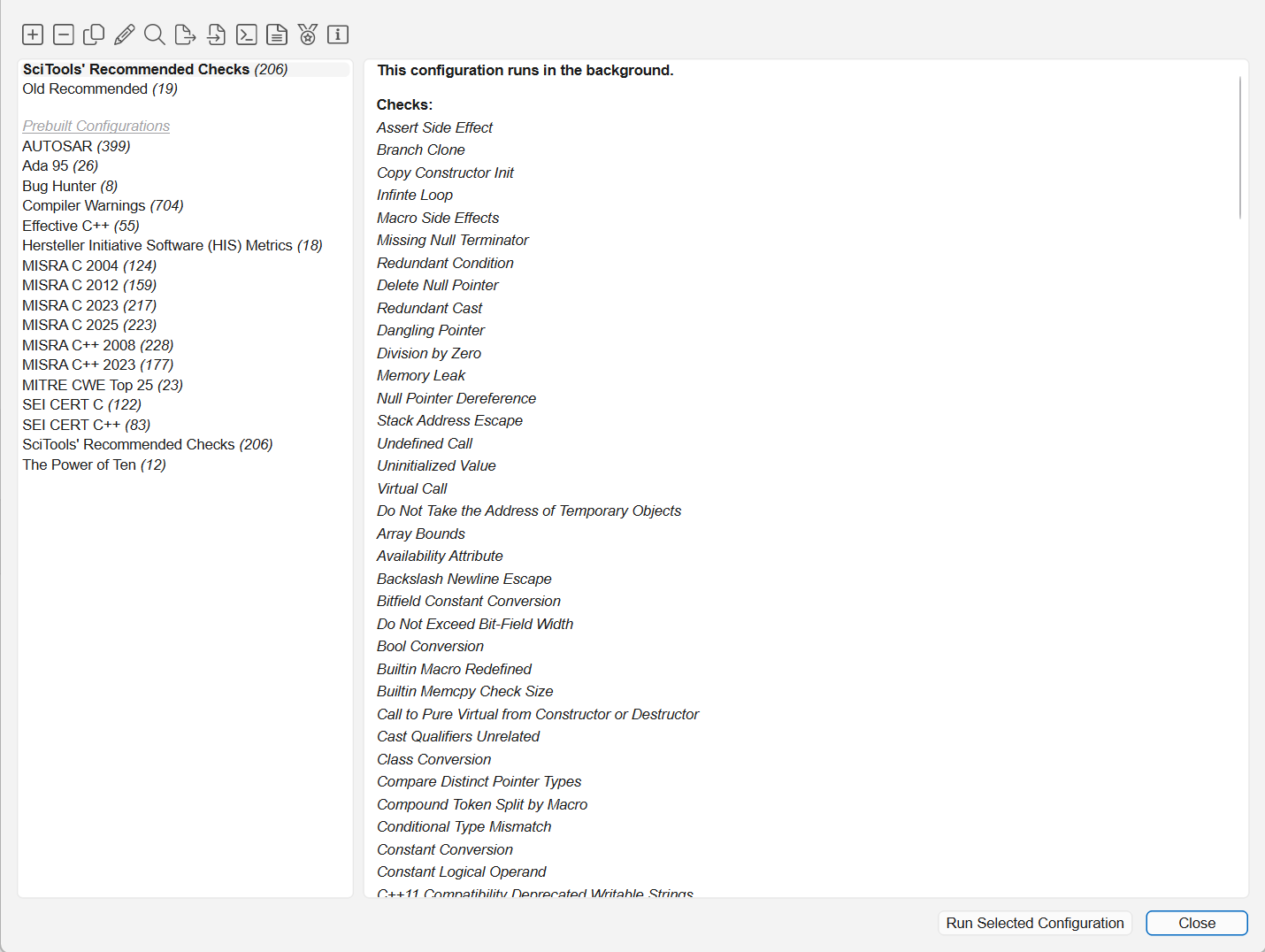
Published standards
Each standard name below links to its coverage-matrix page, which lists every rule and whether it is automated (each page also offers a downloadable PDF).
| Standard | Checks | Automated coverage |
|---|---|---|
| AUTOSAR | 365 | 91% |
| MISRA C 2004 / 2012 / 2023 / 2025 | 108 / 155 / 207 / 209 | 76% / 97% / 95% / 94% |
| MISRA C++ 2008 / 2023 | 214 / 166 | 94% / 93% |
| SEI CERT C / C++ / Java | 96 / 73 / 115 | 79% / 88% / 71% |
| MITRE CWE Top 25 | 13 | 50% |
| Hersteller Initiative Software (HIS) Metrics | 18 | 100% |
| The Power of Ten | 12 | 100% |
| PEP 8 (Python) | 7 | in development |
| Ada 95 | 65 | in development |
| Effective C++ | 17 | 31% |
| Compiler Warnings | 704 | 100% |
| Bug Hunter (C/C++ defect checks) | 8 | 100% |
| SciTools' Recommended Checks | 206 | 100% |
Read the coverage % correctly
Coverage is the share of the standard's rules that CodeCheck can check automatically. The remainder are rules that require manual review (not mechanically decidable). A compliance effort must still account for the non-automated rules — see produce a compliance report.
Standards marked in development ship and are usable — checks are still being added, so no coverage figure is published for them yet.
Per-language check catalogs also exist (C ≈ 2,850 checks, C++ ≈ 2,722, Java 334, Python 66, Ada 136, Fortran 61, VHDL 80, C# 63, Web 46, and more). The full matrix set is indexed in the CodeCheck standards reference.
Where to next
- The HIS limits are also computable as metrics — see HIS metrics.
- Mapping a domain obligation to a standard? See ISO 26262, IEC 62304, and DO-178C.